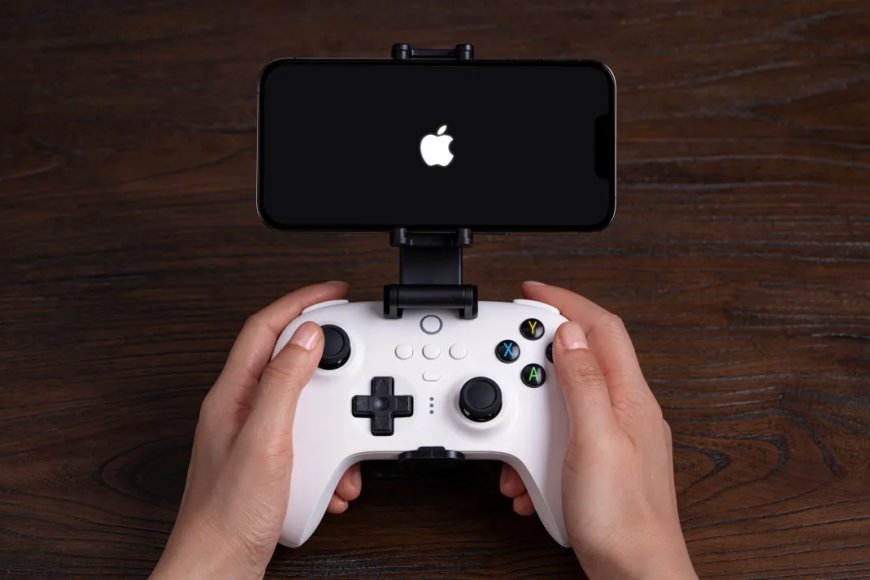
Apple appears to be preparing a much more direct move into mobile gaming hardware. References inside macOS 26.7 point to two unreleased game controllers, while subsequent reporting indicates that both accessories are being developed specifically for the iPhone and could eventually launch under the Beats brand.
Apple has not announced the products, and it has provided no pricing, release date, or final design. Even so, the software evidence is more substantial than a generic patent or concept. Apple built dedicated GameController profiles for two unidentified devices, suggesting that functional hardware has been tested deeply enough to require operating-system support.
Apple’s Software Revealed Two Unreleased Controllers
The clearest evidence emerged from the first release candidate of macOS 26.7. Two hardware identifiers, T6502 and T1057, appeared with dedicated profiles inside Apple’s GameController framework.
According to the macOS 26.7 code findings, both profiles describe hardware with the controls expected of a modern full gamepad, including a directional pad, dual analogue sticks, shoulder controls, and analogue triggers. They also include Home and Menu-style buttons and their own haptic configurations.
The two devices are not identical. T1057 includes accelerometer and gyroscope support, while T6502 does not. That difference suggests Apple evaluated more than one controller configuration rather than maintaining two software entries for the same hardware.
Apple later removed the references from a macOS release candidate. Removal does not establish whether the products were cancelled, delayed or hidden from public software builds, so the code alone cannot establish a launch timetable.
The Controllers Are Reportedly Intended for iPhone.
The appearance of the profiles in macOS initially created uncertainty over what devices Apple intended the controllers to serve—later reporting narrowed the purpose considerably.
Bloomberg’s Mark Gurman reported that Apple has been developing the controllers for more than a year and that they are intended primarily for iPhone gaming. He also said the company sees dedicated mobile gaming controllers as a growing market it wants to enter.
The unusual part is the branding. The accessories are expected to launch under Beats rather than directly as Apple-branded hardware. A report summarising the Beats controller plans says Apple’s audio subsidiary is likely to handle the products.
That approach would not be entirely out of character. Beats has expanded beyond headphones into accessories including iPhone cases and charging cables, giving Apple another brand through which it can experiment with products aimed at younger or more lifestyle-oriented audiences.
Apple Already Has the Software Foundation for Physical Controllers
An Apple-designed controller would not require the company to invent a new input system. iPhone, iPad, Mac and Apple TV already support a broad range of physical controllers through Apple’s established Game Controller framework.
Apple’s Game Controller developer framework provides standardised support for controller buttons, triggers, directional pads, thumbsticks, haptics, lighting and motion sensing. Developers can use the same framework with third-party hardware instead of writing completely different input systems for every controller.
Apple also officially supports popular console hardware. Its current iPhone software can connect compatible Xbox and PlayStation controllers over Bluetooth or wired connections, while users can customise controller mappings for supported games.
The iPhone controller settings also include Buddy Controller, which lets two connected controllers control one player character. That existing software infrastructure means Apple’s rumoured controllers could enter an ecosystem that already understands standardised gamepad input.
First-Party Hardware Could Give Apple More Control Over iPhone Gaming.g
The bigger question is why Apple would build its own controllers when strong third-party options already exist. Products from companies such as Backbone and Razer have spent years turning the iPhone into a more conventional handheld gaming device. At the same time, Bluetooth controllers from Sony and Microsoft work well for players who don’t need a phone-mounted design.
First-party hardware would give Apple control over details those products cannot fully dictate. It could coordinate controller behaviour with iOS, the Apple Games app, system-level button mapping, haptics and future iPhone hardware without waiting for outside accessory makers to adopt new capabilities.
The existence of two profiles also creates room for different product strategies. One controller could prioritise configuration, while the other adds motion sensing and more advanced feedback. The software findings confirm that the two devices have different capabilities, although their physical form factors have not been publicly established.
That distinction matters because there isn’t enough evidence yet to say whether either controller wraps around an iPhone, resembles a traditional standalone gamepad, or uses another attachment system entirely.
Motion Sensors Could Differentiate the Higher-End Model
T1057’s accelerometer and gyroscope are among the most interesting details in the leaked profile. Motion sensing is already familiar in console controllers, but it could be particularly useful when the gaming screen itself is an iPhone.
Gyroscopic aiming, steering, and motion-based interaction could let developers combine conventional controls with controller movement. Apple could also use those sensors for system-level features if the final accessory is designed around a specific physical relationship with the phone.
The separate haptic profiles also suggest Apple has been working below the level of generic Bluetooth controller compatibility. Apple’s Game Controller framework already exposes controller haptics to developers, so first-party hardware could potentially provide feedback designed specifically around iOS games.
Exactly how sophisticated that system will be remains unknown. The software references establish hardware capabilities, not the quality or strength of the final implementation.
Beats Branding Could Help Apple Avoid the Expectations of an Apple Controller
Launching through Beats could give Apple more freedom on both design and price. An Apple-branded controller would immediately invite comparisons with the company’s premium hardware and raise expectations for materials, ecosystem integration and pricing.
Beats has traditionally occupied a more colourful, youth-focused position in Apple’s portfolio. That identity could fit gaming accessories naturally, particularly if Apple wants multiple finishes or a product aimed at iPhone users rather than the broader Mac and Apple TV audience.
It could also let Apple enter the category without implying it’s building a full gaming-console strategy around the accessory. The controller would instead sit alongside other iPhone peripherals while still benefiting from Apple’s software integration.
The Games Matter More Than the Controller
A first-party controller alone will not transform the iPhone into a serious gaming platform. Hardware can make games more comfortable to play, but developers still need compelling titles that benefit from traditional controls.
Apple has spent years improving this side of the equation. iPhones now support major console-style releases alongside Apple Arcade and an enormous catalogue of mobile games, while the Apple Games app gives gaming a more prominent place within iOS.
Physical controls are especially useful for genres that don’t translate comfortably to a touchscreen. Action games, racing titles, platformers, fighting games, and console ports can all benefit from analogue sticks and triggers that don’t obscure the display.
An Apple-designed accessory could make that experience easier for mainstream iPhone owners to understand. Instead of choosing among many third-party designs with different features and app requirements, users would have an option built specifically around Apple’s gaming ecosystem.
What We Still Do Not Know
The biggest unanswered questions are basic ones. Apple has not announced the controllers, revealed their physical designs or explained why it is developing two models. There is also no confirmed price, release date, battery specification, attachment method or compatibility list.
Beats branding is similarly reported rather than officially announced. The products could change substantially before release, and unreleased hardware found inside operating-system code does not guarantee that every tested device eventually reaches consumers.
What makes this development more credible than a typical Apple accessory rumour is the combination of detailed controller profiles and subsequent reporting that Apple has been actively developing the hardware for more than a year.
Apple’s Gaming Ambitions May Finally Be Getting Dedicated Hardware
Apple has supported game controllers for years, but it has largely left the hardware itself to Sony, Microsoft and accessory specialists. Developing its own iPhone controllers would mark a meaningful change: Apple would no longer be providing only the operating-system framework around somebody else’s gamepad.
The strongest opportunity is integration, not novelty. Apple does not need to invent a completely new type of controller. It needs to make physical gaming on the iPhone simpler, more consistent, and more closely connected to the software already built into iOS.
The two controller profiles suggest the work is well beyond a vague internal idea, while the possible use of Beats gives Apple an established consumer brand to enter the market. Until Apple announces the products, however, their final form remains uncertain.
If they do reach consumers, the more important story will not be that Apple finally sells a game controller. It will be whether first-party hardware gives developers and players a stronger reason to treat the iPhone as a genuine handheld gaming platform rather than a phone that also happens to support controllers.