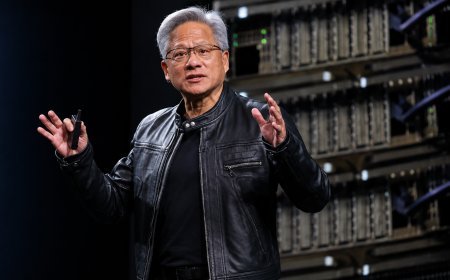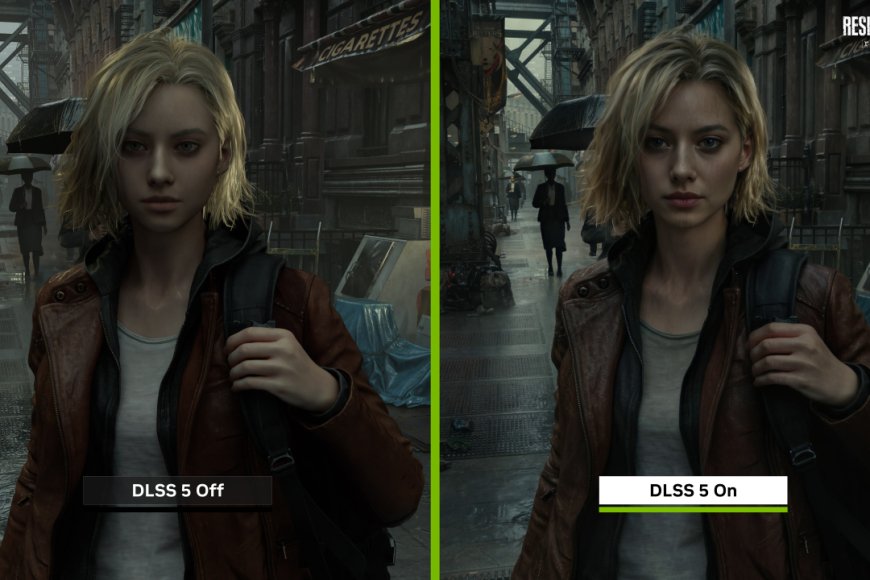
Nvidia CEO Jensen Huang took the stage during the company’s GTC keynote on Monday to introduce DLSS 5, the latest version of Nvidia’s AI-powered graphics technology aimed at delivering more realistic visuals in video games while reducing computational demands.
The updated DLSS 5 system integrates traditional 3D graphics data with generative AI models that can predict and fill in missing portions of an image. This approach allows Nvidia’s GPUs to render highly detailed environments and lifelike characters without needing to compute every element from the ground up.
“We fused controllable 3D graphics, the ground truth of virtual worlds, the structured data … with generative AI, probabilistic computing,” Huang explained during his keynote. “One of them is completely predictive, the other one is probabilistic yet highly realistic.”
According to Huang, combining structured data with generative AI enables developers to produce content that is both visually impressive and controllable.
“This concept of fusing structured information and generative AI will repeat itself in one industry after another,” he said. “Structured data is the foundation of trustworthy AI.”
Although gaming now accounts for a smaller share of Nvidia’s overall revenue than in the past, it remains a foundational part of the company’s history. Huang positioned DLSS 5 as part of a broader evolution in computing, suggesting that the same underlying approach could extend well beyond gaming into enterprise applications.
He highlighted enterprise data platforms such as Snowflake, Databricks, and BigQuery as examples of structured datasets that future AI systems could leverage for analysis and insight generation.
“In the future, what’s going to happen is these data structures are going to be used by AI, and AI is going to be much, much faster than us,” Huang said. “Future agents are going to use structured databases as well as the unstructured database, the generative database. This database represents the vast majority of the world.”