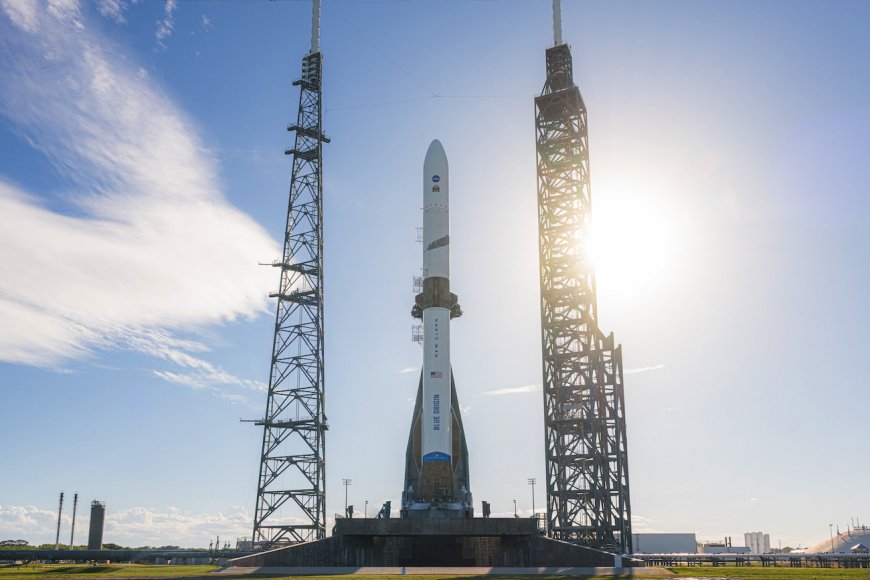
The intense solar activity dazzling skies across North America this week has now grounded Jeff Bezos’ space company, Blue Origin. Just hours before liftoff on Wednesday, the company announced it was standing down from the second launch of its New Glenn rocket from Cape Canaveral, Florida, citing concerns about the solar storm’s potential effects on NASA’s ESCAPADE spacecraft, a twin-probe mission bound for Mars.
“We’re standing down from today’s attempt due to solar activity and its potential effects on the ESCAPADE spacecraft,” Blue Origin said in a statement.
A new launch date has not been set yet.
Caution for a Crucial Commercial Flight
This mission was meant to mark a significant milestone for Blue Origin — New Glenn’s first commercial launch. The company’s January debut flight successfully demonstrated most of the rocket’s systems, but this second mission carries NASA’s ESCAPADE payload, making reliability the top priority.
The ESCAPADE (Escape and Plasma Acceleration and Dynamics Explorers) probes are designed to study the magnetic environment of Mars, making them highly sensitive to solar radiation. Blue Origin said it will wait until the solar storm subsides before attempting launch.
Launch Troubles Continue
Blue Origin had been close to launching earlier in the week. On Sunday, the company’s attempt was scrubbed due to weather issues, minor launch-pad equipment problems, and even an errant cruise ship entering the rocket’s flight corridor.
Each postponement adds pressure for Blue Origin, which is working to prove that New Glenn can compete with SpaceX’s Falcon Heavy in the commercial launch market.
A Powerful Rocket Still Waiting to Fly
Standing over 320 feet tall, New Glenn is designed for reusability and heavy-lift missions. It’s capable of carrying payloads exceeding 45 metric tons to low-Earth orbit, putting it among the most powerful rockets ever built.
With this latest delay, the company is expected to announce a new launch window later this month, pending space-weather forecasts and NASA’s approval for the Mars-bound payload.